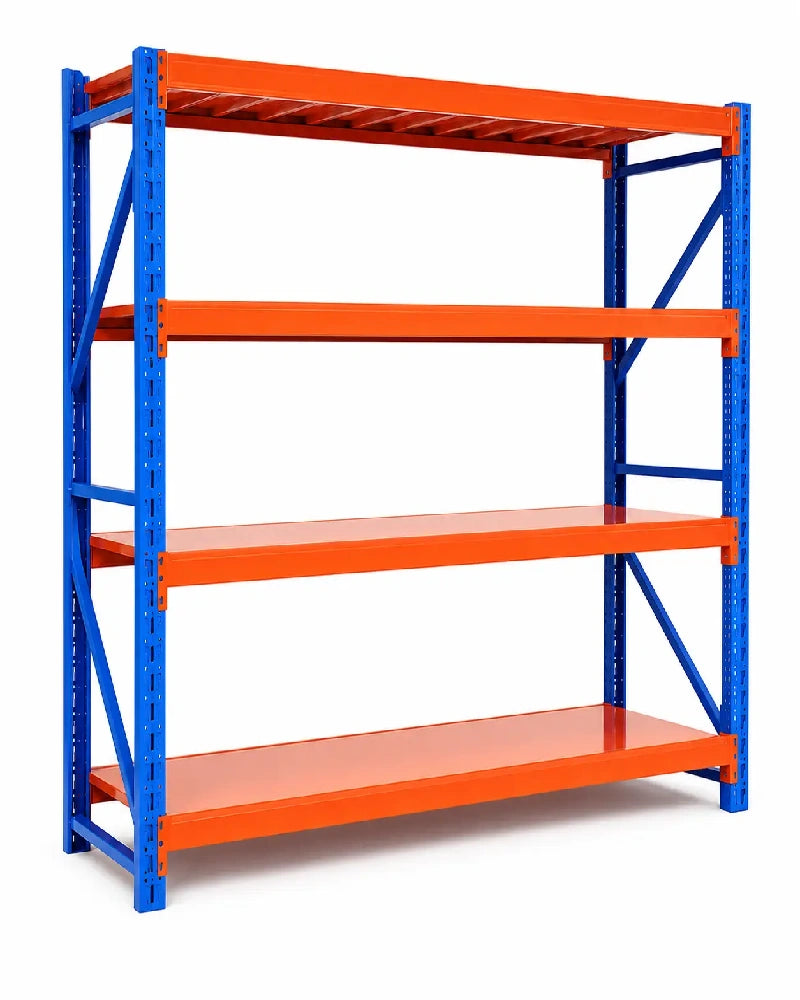


Steel shelf decking and wire decking solve different garage-storage problems. A solid steel deck gives small items and flat-bottomed containers a continuous surface, while an open wire deck allows more air and light to pass through. Neither is automatically better: the right choice depends on what you store, how you handle spills, how often you clean, and whether trays or liners are compatible with the exact shelving system.
This guide compares the deck surfaces themselves—not the overall strength of two shelving units. Frame design, beam spacing, deck supports, assembly, anchoring and the manufacturer’s stated load conditions all affect a complete system. Always check those details for the exact model rather than transferring a rating from a similar-looking shelf.
Steel decking vs wire decking at a glance
| Garage consideration | Solid steel decking | Wire decking |
|---|---|---|
| Small loose items | Continuous surface reduces gaps, but a parts tray is still easier to organise | Use closed bins or trays sized so they cannot tip or pass through the openings |
| Spills and leaks | Liquid stays on the level until removed or reaches an edge or joint | Liquid can pass through to shelves and the floor below |
| Air and light | Blocks more airflow and overhead light | Openings allow more air and light through the bay |
| Routine cleaning | Broad surface is straightforward to wipe, with attention to seams and edges | Access both the wires and intersections; debris may fall below |
| Container base | Supports more of a flat base continuously | Works best when the base is rigid and spans the openings securely |
This is a use-case comparison, not a capacity comparison. Two decks made from steel can still have different construction, supports, coatings and permitted loads.
Choose solid steel decking for a continuous surface
Solid steel decking creates a flat platform across the shelf level. That makes it practical for small tool cases, parts organisers, paint tins with sound bases, and storage containers that do not sit well across wire openings. The continuous surface can also make it easier to slide a rigid bin into position, provided the product instructions allow sliding and the bin stays within the shelf edges.
A solid deck does not replace good containment. Screws, washers, clips and other small parts are easier to inventory in a divided tray or closed box than loose on any shelf. Containers holding liquids should remain sealed and suitable for their contents, and any secondary containment must be compatible with the stored material and local requirements.
What happens when something leaks?
On a solid deck, a small leak will usually remain on that level until it is wiped up, reaches an edge, or finds a seam or opening. This may make the leak easier to notice, but it can also spread beneath neighbouring containers. A solid shelf is not a spill-control system, and the shelf finish should not be assumed resistant to chemicals, fuels, cleaners or moisture.
If your garage contains regulated, flammable, corrosive or otherwise hazardous products, follow the product label, applicable local storage rules and advice from a qualified professional. Do not rely on the choice of shelf deck as the safety control.
Cleaning a solid deck
For ordinary dust and dry debris, unload the level as instructed and wipe the broad surface with a method approved for the finish. Pay attention to folded edges, seams and the places where a removable panel meets its supports. Do not saturate joints or use a cleaner that the manufacturer has not approved. Before reloading, check that the deck is dry, correctly seated and free from damage.
Choose wire decking when openness matters
Wire decking leaves much of the shelf surface open. This allows more air and light to move through the storage bay and makes it easier to see the underside of containers. For garages where items are kept in large, rigid bins, wire can provide a clear and practical platform—if each bin base is large and stiff enough to span the openings as the shelving instructions require.
The trade-off is that loose fasteners, narrow feet and flexible packages may sit unevenly or pass through the grid. A compatible tray, shelf liner or closed container can solve that handling problem, but do not add an accessory until you have checked its fit, material, retention method and effect on the manufacturer’s use conditions.

Wire decking changes where debris goes
Open decking does not make dust disappear. Fine debris and liquid can pass to the level below or reach the garage floor, so cleaning may involve the shelf, the stored items and the space underneath. Wire intersections and support channels may also need attention. If the shelf is near a workbench, avoid positioning uncovered items where filings, sawdust or drips can fall onto them.
For a leak-prone item, use a suitable closed container or approved secondary tray rather than expecting the wire to manage the spill. Keep incompatible materials separated according to their labels and applicable rules.
Match the deck to the actual item base
Before choosing, list the containers that will occupy each level. Measure the base—not just the widest point—and look for moulded feet, wheels, ridges or flexible sections that change how it contacts the deck. Then compare those features with the usable shelf depth, wire spacing, panel joints and support layout shown for the exact model.
Use this simple test:
- Identify the smallest contact points on the container base.
- Confirm that the whole container can remain inside the usable deck area.
- Check whether every contact point is supported without rocking or snagging.
- Confirm that any tray or liner is approved and cannot slide out of position.
- Verify the shelf’s model-specific load limit and all conditions attached to it.
Do not bridge an opening with scrap board, cardboard or an improvised panel. An unapproved insert can move, trap moisture, conceal damage or change how the load reaches the supports.
Compare the complete shelf, not only the deck
Deck material is one buying criterion. Also inspect the frame connections, front and rear beams, intermediate supports, feet, shelf-adjustment positions and instructions for anchoring or restraint. Ask whether the deck is integral or removable and whether replacement panels, clips, liners or dividers are documented for that model.
Read capacity figures carefully. Check whether a stated limit applies to one level or the complete unit, whether it assumes an evenly distributed load, and whether it depends on a particular shelf layout or anchoring method. Put denser items lower, keep loads within the deck edges, and never climb the shelving. For a broader planning process, use the garage shelving guide.
A practical decision guide
Solid steel is often the simpler shortlist when:
- many containers have small feet or narrow, flat bases;
- you frequently handle parts trays and compact tool cases;
- you prefer wiping one broad surface;
- you want to reduce the chance of ordinary loose items falling through the deck.
Wire is often the simpler shortlist when:
- most items are held in large rigid containers;
- air and light movement through the shelving bay matter to your layout;
- you can access the shelf and floor below for cleaning;
- the grid spacing and supports are documented and suit the container bases.
A mixed setup may be the best answer
Some garages benefit from solid levels for small-item storage and wire levels for larger bins. A tray placed on a compatible wire deck can also create a contained area for small parts. Treat mixed configurations as product-specific: use only deck types and accessories that the exact shelving system permits, and do not assume parts from another model will fit.
If you are still comparing materials beyond these two deck styles, read our broader metal, wood and wire shelving guide.
Frequently asked questions
Is steel decking stronger than wire decking?
Not necessarily. Capacity depends on the complete shelf design, including deck thickness or wire construction, beam spacing, support bars, connections and stated load conditions. Compare verified ratings for the exact models.
Can small items go directly on wire shelving?
Only when their bases are stable across the openings. A closed parts organiser or compatible tray is usually more practical for fasteners and other small pieces.
Does wire decking prevent moisture problems?
No. Open wire allows more air to pass, but it does not prevent condensation, corrosion, leaks or moisture damage. Check the environment, finish and manufacturer’s care instructions.
Can I add a liner to wire decking?
Only after confirming that the liner is compatible with the exact shelf, stays securely positioned, and does not conflict with ventilation, cleaning, fire-safety or load instructions.
Which deck is easier to clean?
Solid decking offers a broad wipeable surface, while wire allows debris to pass through but requires cleaning around the grid and below. The easier option depends on your stored items and access.
Which decking is better for paint, oil or garden chemicals?
Deck style alone does not determine safe storage. Follow every product label and applicable local rules, use suitable closed containers and secondary containment where required, and seek qualified advice for hazardous materials.
Can I replace a solid deck with wire, or wire with solid steel?
Do so only when the manufacturer documents the replacement for that exact shelving system. The new deck must fit the beams and supports and preserve all required load and installation conditions.
Choose from verified model details
Start with what sits on each shelf, then decide whether a continuous surface or an open grid solves more of your daily storage problems. Once you have that answer, compare the complete frame, deck supports, dimensions, included parts, assembly instructions and model-specific load conditions. Browse the current Heavy-Duty Shelving collection and verify the exact product details before ordering.
Need help choosing?
Find the right storage solution for your space.
Tell us about your room, workspace, quantity, or project requirements and our team will help you compare suitable options.