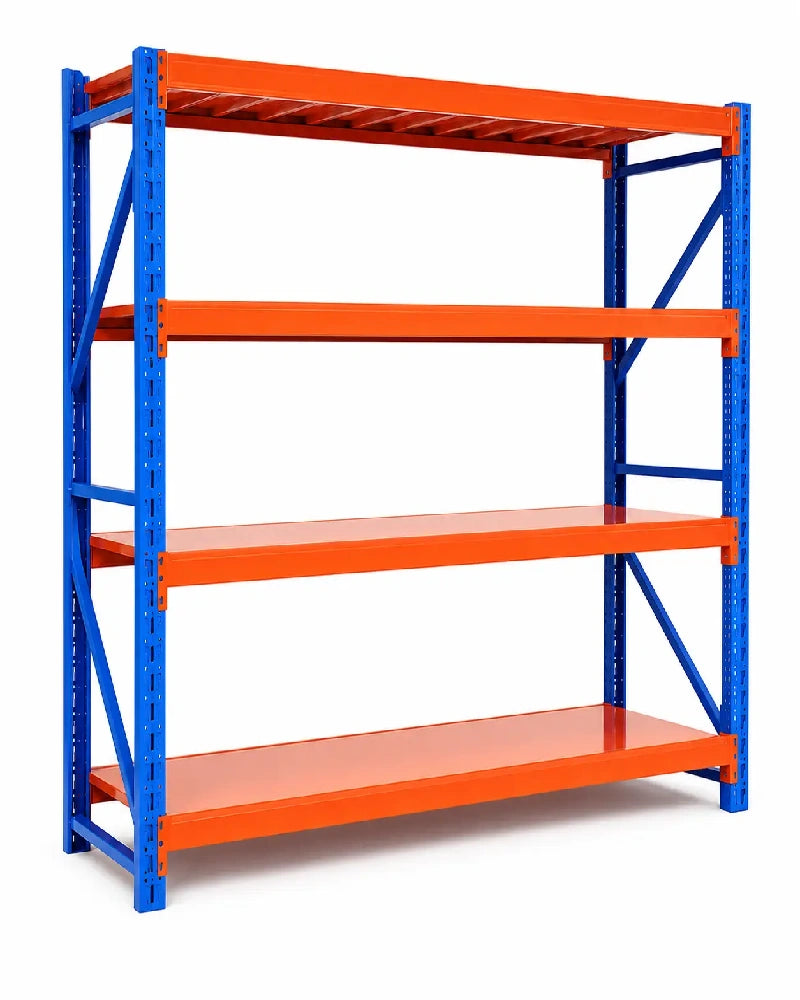


The right garage shelf clearance is the space that keeps every moving object and access point usable after the shelf is installed. There is no single distance that fits every garage. Park the vehicle where it normally sits, open doors and hatches fully, mark the proposed shelf footprint, then reserve enough room for people, storage bins, doors, outlets and garage-door hardware to move without contact.
This guide gives you a practical way to calculate that space in either millimetres or inches. It is a layout test, not a substitute for the shelving instructions, building rules or advice from a qualified professional.
Start with the shelf footprint, then measure what must move
A shelf's listed width and depth describe the unit, but they do not describe the working space around it. The usable layout is the garage dimension minus the shelf footprint and every movement zone that needs to stay clear.
Use this planning equation:
Available clearance = measured open space − shelf depth − required movement or access zone
Do not choose the movement zone from a generic chart. Create it from the objects and people that will actually use the garage. For example, open the widest vehicle door, carry the largest storage tub along the intended route, swing the side door, and run the garage door through a complete cycle while standing clear of moving parts. The shelf must remain outside those swept areas.
If you have not recorded the room yet, begin with our step-by-step garage measuring guide.
Clearance beside a parked car
Measure with the car in its normal parking position, not centred for convenience. Drivers often park slightly differently from day to day, so repeat the test after several normal arrivals if the fit is tight.
- Mark the outer face of the proposed shelf with removable painter's tape.
- Open the driver, passenger and rear doors to the positions you normally need.
- Open the hatch, tailgate or boot if items are loaded from inside the garage.
- Walk between the open door and the tape without turning sideways or touching either surface.
- Carry the largest item you expect to move through that route.
If a door touches the taped line, a person has to squeeze through, or a bin must be lifted over the vehicle, the proposed clearance is not practical. Reduce shelf depth, move the shelf to another wall, or change the parking position. A layout that only works when the vehicle is perfectly aligned is likely to create daily frustration.

Walking and carrying clearance in front of shelves
The space in front of a shelf is a working aisle, not just an empty strip of floor. It must accommodate the user, the shelf doors or bins if present, and the object being removed.
Test the aisle with the shelf footprint taped on the floor. Face the tape as though reaching for an item, bend safely, turn, and walk away carrying a representative container. Test with the bulkiest normal item rather than the smallest box. If two people often share the garage, check whether one person can pass while the other is using the shelf.
Keep the route to the house, driveway and emergency exits free of stored items. Do not count temporary clutter as acceptable clearance, and do not plan to place containers permanently in the aisle.
Doors, windows and access panels
Draw the full swing arc of every hinged door on the floor. Include the door handle, not only the door slab, and test the door with the shelf footprint in place. Sliding doors need a clear track and enough hand access to operate them.
Windows may need room to open, clean and lock. Plumbing shut-offs, inspection covers and service panels must also remain reachable. If access would require unloading or dismantling the shelf, choose another position.
Outlets, switches and electrical equipment
Do not hide outlets, switches, chargers, distribution boards or electrical panels behind shelving. Leave cords visible and protected from crushing, sharp shelf edges and vehicle contact. Never route extension leads through shelf frames or underneath loaded units where damage cannot be seen.
Required working space around electrical equipment varies by location and installation. Follow local electrical rules and use a licensed or otherwise qualified electrician when the placement is uncertain. The safe decision is to keep the shelf outside the equipment's required access area rather than treating a small gap as sufficient.
Garage-door tracks, motors and moving hardware
Measure vertical clearance with the garage door both open and closed. Watch the full path of panels, tracks, springs, arms, cables and the opener. Shelves and stored items must not enter that moving envelope or obstruct inspection and servicing.
Do not stand beneath or touch moving components during the test. If shelving would sit near springs, cables, brackets or the opener, ask a qualified garage-door professional to confirm safe access. Product height alone is not enough; objects placed on the top shelf also need to stay clear.
Ceiling, lighting and ventilation clearance
Include the height of the tallest item you plan to store, not only the shelf frame. Keep light fittings, ceiling fans, vents and detectors unobstructed. Avoid layouts that force you to tilt large items into a light or climb above the safe reach described in the product instructions.
If the garage contains heating equipment, fuel-burning appliances, battery systems or other equipment with manufacturer-specified clearance, follow those instructions and local requirements. Do not use a general shelving article to set that distance.
Corner layouts need two clearance checks
Two shelves meeting at a corner can create hidden interference. The front corner of one unit may block access to the end bays of the other, and large bins may not turn through the remaining angle.
Tape both footprints at the same time. Place representative boxes inside the outlines, then simulate removing them from every bay. If a container collides with the other shelf's face, leave a larger corner gap, shorten one run or use the corner for small, infrequently handled items.
A five-minute clearance test before buying
- Measure the exact shelf footprint. Use the current product specification or packaging information rather than an estimated category size.
- Tape the outline. Mark width and depth on the floor and height on the wall using removable tape.
- Move everything. Open vehicle doors, the boot or hatch, house doors, windows and the garage door.
- Carry a real load. Walk the normal route with your largest common container while keeping a comfortable grip and view of the path.
- Check fixed services. Confirm that outlets, switches, panels, vents and shut-offs remain visible and reachable.
- Test top-shelf storage. Add the height of stored objects and confirm that lights and door hardware remain clear.
- Repeat after normal parking. Make sure the plan still works when the vehicle is not positioned with survey-level precision.
What to do when clearance is tight
Start by changing shelf depth, because a shallower unit can recover aisle and door space without shortening the storage wall. Next, consider moving the shelf to the back wall, separating one long run into shorter zones, or keeping bulky items lower so they can be removed without lifting into overhead hardware.
Do not solve a tight layout by blocking an exit, covering electrical access, placing storage in the vehicle path or stacking above the shelf's intended configuration. Follow the product's assembly, loading and anchoring instructions. Where wall fixing or structural suitability is uncertain, consult a qualified professional.
Garage shelf clearance checklist
- The parked vehicle and its doors do not touch the shelf or stored items.
- A person can walk and carry the largest normal container without squeezing or twisting.
- House doors, gates, windows and cabinets complete their full movement.
- Outlets, switches, panels and service points remain accessible.
- The garage door and all moving hardware remain clear in every position.
- Top-shelf contents do not obstruct lights, vents, detectors or equipment.
- The final unit can be installed and used according to its current instructions.
Once your taped layout passes every test, compare the verified dimensions of suitable units in the Garage Shelving collection. Check the current product page before ordering because dimensions, components and availability can vary by product.
Frequently asked questions
Is there one standard clearance for garage shelves?
No single distance works for every garage. Clearance depends on shelf depth, vehicle position, door movement, users, stored items, services and local requirements. A taped real-world test is more reliable than a universal number.
How do I measure clearance between shelves and a car?
Park normally, tape the shelf's outer face on the floor, open every vehicle door and hatch you use, then walk and carry a typical large item through the remaining space. The tape must stay outside every movement path.
Should I leave space behind freestanding shelving?
Follow the unit's instructions and account for skirting boards, wall irregularities, plugs, pipes, anchoring requirements and inspection access. Do not assume the frame can sit flush against every wall.
Can shelving go in front of a power outlet?
Avoid covering outlets or creating cord pinch points. Electrical equipment must remain accessible, and required working clearances should be confirmed under local rules or with a qualified electrician.
How much room is needed in front of shelving?
Reserve enough room for the user to face the shelf, remove the largest normal item, turn and leave along the intended route without contacting a vehicle, door or other storage. Test that movement before choosing the unit.
Can a tall shelf sit under a garage-door track?
Only if the frame and every stored item remain outside the complete moving and service envelope specified for the door system. If the fit is close to tracks, springs, cables or the opener, obtain professional advice.
What if the taped footprint fails the clearance test?
Choose a shallower or narrower configuration, move the shelf, split the storage run, or revise the parking position. Do not trade away safe access to doors, electrical equipment or garage-door hardware.
Need help choosing?
Find the right storage solution for your space.
Tell us about your room, workspace, quantity, or project requirements and our team will help you compare suitable options.