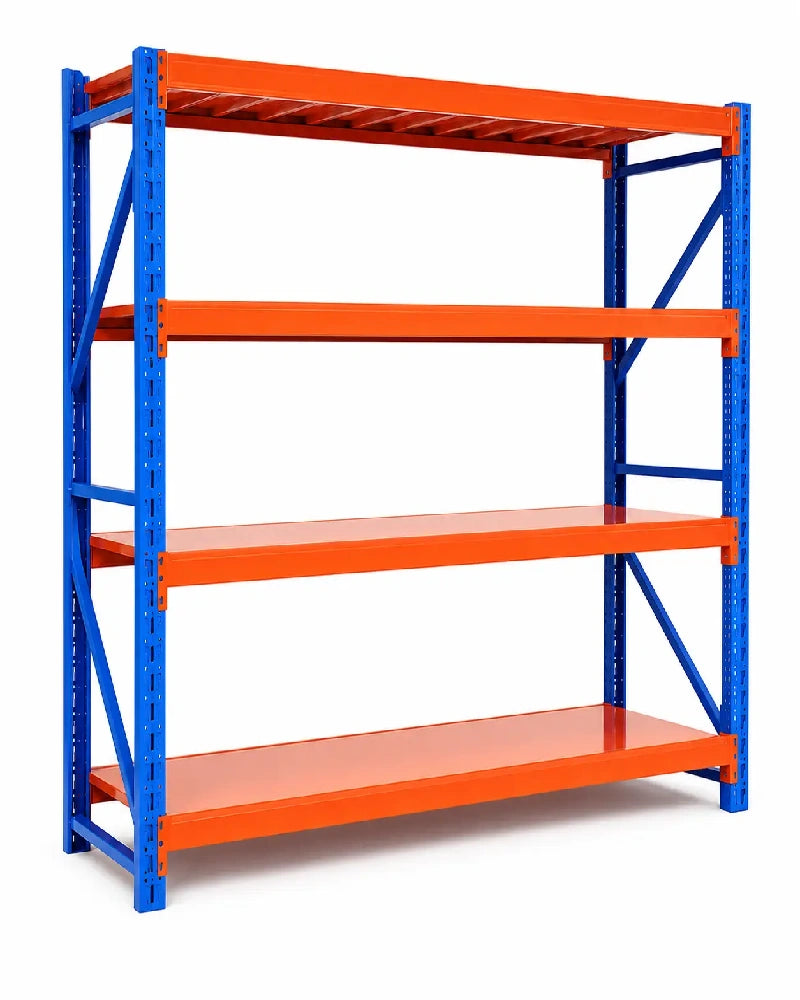


To store long, bulky and awkward items on shelving, start with the object—not the empty shelf. Record its dimensions, weight, balance point, shape, handling method and how often you need it. Then choose storage that supports the item along its length, prevents rolling or sliding, keeps it within the shelf footprint and leaves a clear route for retrieval. If an item cannot sit securely without projecting into an aisle, use a purpose-made rack, cradle, bin or floor-level storage zone instead of forcing it onto a standard shelf.
Why awkward items need a different storage plan
Standard cartons are easy to stack because they usually have flat faces and predictable centres of gravity. Long timber, pipes, folded gazebos, ladders, sports equipment, large tubs and irregular machine parts behave differently. They may roll, flex, tip, snag clothing or require two people to move. A load can be within a shelf's stated rating and still be poorly stored if it is unstable, concentrated on a small contact point or difficult to retrieve.
The practical goal is not to fit the greatest possible volume onto a rack. It is to create a storage position where the item remains supported, contained and accessible during normal use. For workplaces, applicable rules and the site's risk assessment also matter. In the United States, OSHA's materials-handling rule requires storage to remain stable and secure and passageways to stay clear. Safe Work Australia likewise identifies the size, shape, weight and location of a load as factors in hazardous manual tasks.
1. Build an item profile before choosing a shelf
Measure the item's full length, width and height in the position in which it will be stored. Do not rely only on packaging dimensions or the nominal size. Note handles, wheels, lids, protrusions and flexible sections. For bundles, record the secured bundle size rather than the size of a single piece.
- Weight: use reliable documentation or a suitable scale; do not guess from appearance.
- Centre of gravity: note whether the item is balanced or heavier at one end.
- Contact area: check whether it rests on a broad base, narrow feet, curved surface or sharp edge.
- Movement: identify whether it can roll, slide, unfold, leak or release stored energy.
- Access frequency: separate frequently used items from seasonal or archive storage.
- Handling: decide whether one person, two people or appropriate equipment is needed.
Next, compare this profile with the exact shelving instructions and labels. Check the permitted load per shelf and per unit, whether ratings assume an evenly distributed load, the usable deck dimensions, required shelf spacing, acceptable load contact and any anchoring or floor requirements. A generic description such as “heavy duty” is not a load rating.
2. Keep long items fully supported
Long items should not be balanced across a shelf with an unsupported end extending into a doorway, vehicle path or walkway. Overhang makes the object easier to strike and can shift the load away from the intended support points. It may also place concentrated force on an edge that was not designed for it.
Where a long item fits within the shelving footprint and the manufacturer permits that loading arrangement, use enough support points to prevent sagging or rotation. Keep the item parallel to the shelf edge, away from uprights and connectors that could be damaged. Use compatible dividers, stops or restraints only when the shelving or accessory documentation supports them.
If the item is longer than the usable shelf surface, choose storage designed for long materials: for example, a suitable horizontal rack, cradle or compartment that supports the full item and prevents rolling. Vertical storage may be appropriate only when a purpose-made system restrains the item at suitable points and the location does not allow it to fall into a traffic area. Do not improvise hooks, drill into the frame or tie loads to a shelf unless the manufacturer approves that modification.
3. Give bulky containers a stable footprint
Bulky tubs, equipment cases and large cartons need a shelf deep and wide enough for their actual base. Centre the item so it does not project into the aisle or press against the frame. A container that hangs beyond the deck can be caught by a person, door or vehicle, and its base may not distribute force as intended.
Prefer intact containers with secure lids and usable handholds. Do not stack damaged, bowed or soft-sided boxes simply because there is vertical space. If several items must share a shelf, keep the arrangement simple enough that one can be removed without pulling other objects forward. Label containers outside the generated image workflow or use a separate inventory list so that contents can be found without repeated lifting.
4. Contain round and irregular shapes
Round, tapered or asymmetrical objects need positive containment. A stable bin, cradle, divider or model-compatible stop can prevent them from rolling or shifting. The containment device itself must fit the shelf and must not introduce sharp edges, unstable stacking or new trip hazards.
Do not wedge an irregular item between uprights, brace it with loose offcuts or depend on friction alone. Avoid storing loose poles, cylinders or balls on an open shelf where removing one item could release the rest. Keep straps, cords and folding components secured according to the product's own instructions, without creating loops that hang into the access route.
5. Plan shelf height around access and handling
Storage height should reflect both the load and the person retrieving it. Large or awkward objects can block the user's view and move their centre of gravity away from the body. Safe Work Australia's Hazardous Manual Tasks model code highlights large, bulky or asymmetrical loads and awkward reaching as risk factors.
Place frequently handled awkward items where they can be accessed without climbing, twisting or reaching across other loads. Do not assume that “heaviest on the bottom” solves every problem: floor-level retrieval can require deep bending, while waist-height storage may reduce reaching but must remain within the shelf's verified loading conditions. Choose a height using the item's weight, shape, access frequency, available handling equipment and the people doing the task.
If retrieval would require a person to catch a shifting item overhead, stop and redesign the storage position. For heavy or hard-to-grip objects, use suitable mechanical assistance or trained help rather than treating shelving as a lifting aid.
6. Protect aisles, doors and services
Measure the full storage footprint with the item in place, not just the rack. Preserve clearance for doors, vehicles, garage-door hardware, electrical panels, fire equipment, switches and normal walking routes. Nothing should project at head, shoulder or shin height where it can be struck.
A simple tape outline on the floor can reveal whether a large container will narrow the route when its lid is opened or when it is pulled forward for lifting. For more layout checks, see our guide to heavy-duty shelving dimensions.
7. Separate incompatible or higher-risk items
General storage shelving is not automatically suitable for fuels, gas cylinders, chemicals, batteries, food, hot items or other regulated materials. Follow each item's label and safety information, the shelving instructions and applicable local requirements. Use storage specifically designed for the hazard where required, and obtain qualified advice for workplace, hazardous-material or structural decisions.
Keep wet, leaking, sharp or contaminated items out of ordinary bins until they are made safe using the relevant procedure. Do not let containment trays, straps or covers conceal corrosion, deformation or damaged shelf connections during inspection.
8. Test the retrieval sequence
Before calling the layout finished, rehearse how the item will leave the shelf. Ask:
- Can the user approach it without moving unrelated loads?
- Are secure handholds accessible before the item shifts?
- Can it clear the shelf above, uprights and doorway?
- Will the user still see the travel path while carrying it?
- Is there a stable place to set it down?
- Does the task require another person or suitable handling equipment?
If the sequence depends on climbing the shelving, pulling from one end, catching a rolling object or standing in a vehicle path, revise the layout. For load placement principles, read our guide to weight distribution on heavy-duty shelves, then confirm every recommendation against the exact model documentation.
A practical selection checklist
- The item fits within the usable storage footprint without unsafe overhang.
- The shelf or purpose-made rack supports the item at suitable points.
- The exact load conditions are within the manufacturer's documented limits.
- Round, flexible or asymmetrical items cannot roll, slide, unfold or fall.
- The container and any restraint are compatible with the storage system.
- The access height and route suit the people and equipment doing the task.
- Doors, services, vehicles, work areas and walkways remain clear.
- The arrangement can be inspected without dismantling the entire bay.
If you are selecting a system rather than reorganising an existing one, start with our complete shelf buying guide. You can also browse the current Heavy-Duty Shelving collection and compare each product's documented dimensions, load conditions and installation requirements with your item profile.
Frequently asked questions
Can long items overhang a shelf?
Avoid overhang that enters a walkway, doorway or work area, or leaves the item unstable. If the full length cannot be supported within the shelf's documented conditions, use a purpose-made long-material rack or another suitable storage zone.
Should bulky items always go on the bottom shelf?
No single height is correct for every item. Consider weight, shape, handling frequency, bending and reaching, the user's abilities and the shelving instructions. The chosen position must be both stable and retrievable.
How do I stop round items rolling off?
Use a suitable bin, cradle, divider or compatible restraint that contains the item without altering the shelving. Do not rely on loose wedges or friction alone.
Can I strap long items to a shelving frame?
Only if the shelving manufacturer approves the attachment and loading method. Unapproved drilling, hooks or tie points may damage the frame or create forces the system was not designed to carry.
What if an awkward item is within the stated weight limit?
Weight is only one condition. Check load distribution, contact points, stability, usable dimensions, restraint, access and the exact meaning of the rating in the product documentation.
How often should this storage be inspected?
Inspect it at a frequency appropriate to use and risk, and immediately after an impact, move, overload concern or visible shift. Follow the shelving manufacturer's inspection and maintenance instructions and applicable workplace requirements.
When should I use professional advice?
Seek qualified advice when storage involves structural attachment, pallet racking, hazardous materials, workplace traffic, heavy handling equipment or any situation not clearly covered by the product instructions and local rules.
Need help choosing?
Find the right storage solution for your space.
Tell us about your room, workspace, quantity, or project requirements and our team will help you compare suitable options.