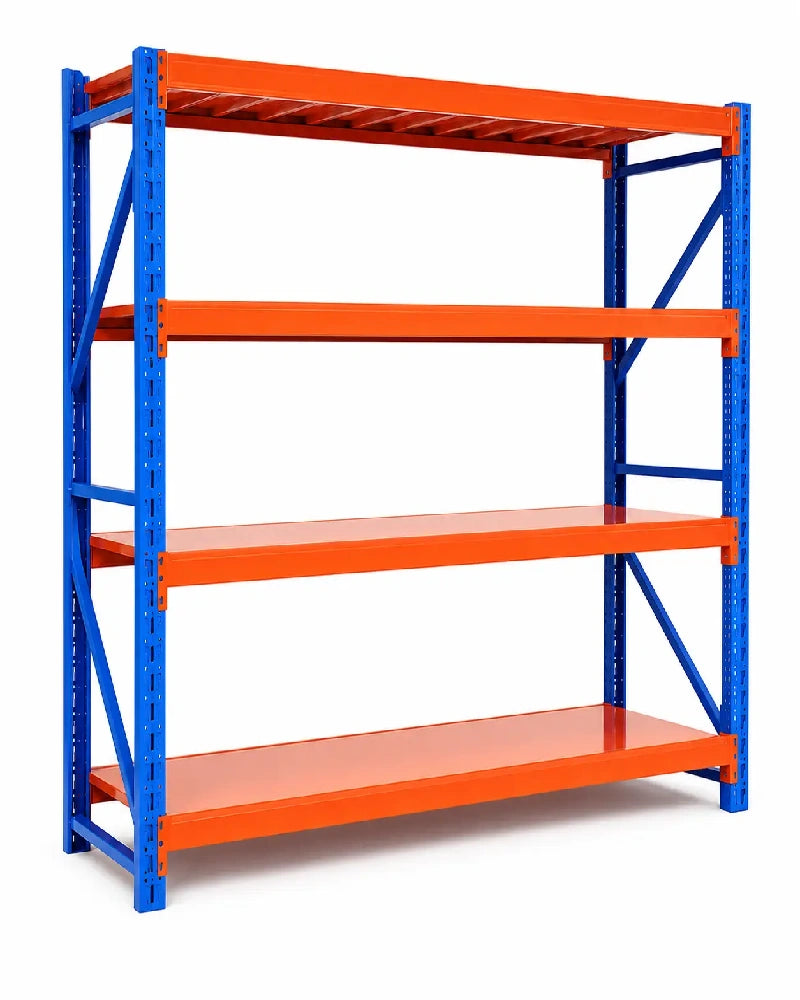


For bulky shelving in Melbourne, choose pickup only after the seller confirms the exact item, collection location, package count, packed dimensions, packed weight and pickup window—and only if your vehicle can carry and restrain every package safely. Choose delivery when the cartons do not fit comfortably, the load would be difficult to secure, or a postcode-specific freight service gives you a safer and more practical result.
Do not compare pickup and delivery on the headline price alone. The better option depends on the exact shelving package, your vehicle, help at both ends, access conditions and the written delivery or collection terms. This guide is a buying checklist, not a promise that pickup is available for every RockShelfIt product.
Quick comparison: pickup or delivery?
| Check | Pickup may suit | Delivery may suit |
|---|---|---|
| Availability | The exact SKU and pickup appointment are confirmed in writing | A delivery service or freight quote is available for your postcode |
| Vehicle fit | Every sealed package fits inside a suitable vehicle or trailer | Packages exceed your safe cargo space or vehicle limits |
| Load restraint | You have suitable rated restraint equipment and know how to use it | You cannot create a secure, legal transport arrangement |
| Handling | Suitable help and equipment are available at collection and home | Carrier handling reduces an impractical lifting or transport task |
| Access | The collection and unloading routes are confirmed and clear | Site access can be described and agreed through a freight quote |
| Total cost | Travel, time, fuel, tolls and equipment still make sense | The quoted charge is competitive with the full pickup cost |
First confirm whether pickup is actually offered
A Melbourne or Victorian fulfilment reference does not automatically mean customer pickup is available. A location may be used for storage or dispatch without operating as a public collection counter. Before planning a trip, ask the seller to confirm:
- the exact product or variant is available for collection;
- the collection address and whether an appointment is required;
- the earliest confirmed pickup window and any identification needed;
- the number of cartons, plus each carton's packed length, width, height and weight;
- whether staff can help load, and what that assistance includes;
- whether a pallet, forklift or other equipment affects vehicle choice; and
- what happens if stock or the pickup appointment changes.
RockShelfIt's current Australian Stock collection identifies selected products held at its Nunawading, Victoria location. That collection is the appropriate place to check current candidates, but it does not by itself confirm that customer pickup is available. Verify the exact item and collection arrangement before ordering or travelling.
Measure the packages, not the assembled shelf
An assembled shelf's dimensions do not tell you whether its cartons will fit in a car, ute, van or trailer. Bulky shelving may arrive in more than one long, flat or heavy package. Ask for the packed dimensions and weight of every carton, including any pallet or protective frame that must travel with it.
Then measure the vehicle's usable cargo opening and internal space. Check the narrowest width between wheel arches, the height at the door or tailgate, the available flat length with seats in their intended position and the location of suitable restraint points. Make sure the driver can close doors or gates as intended and maintain clear visibility.
Do not assume a carton will fit diagonally because its nominal length is less than the vehicle's longest internal dimension. The loading opening, interior trim, seat position and turning angle can prevent a real package from entering. A tape measure and a simple cardboard outline are more reliable than visual estimation.
Check vehicle limits and load restraint
Vehicle fit is only the first gate. The vehicle, trailer, roof system and restraint points must also be suitable for the load and remain within their documented mass and dimension limits. Do not place shelving cartons on seats, allow them to interfere with the driver, or depend on closed doors alone to prevent movement.
The National Heavy Vehicle Regulator's Load Restraint Guide points light-vehicle users to guidance covering cars, utes, vans and trailers up to 4.5 tonnes gross vehicle mass. Its loading guidance emphasises choosing a vehicle with suitable capacity and dimensions, positioning the load for stability and using an appropriate restraint system. Follow current Victorian road rules, the vehicle and restraint manufacturers' instructions, and qualified advice where the correct method is uncertain.
If the cartons require unsafe projection, improvised tie points, an overloaded roof rack or an unstable arrangement, delivery is the better choice. Saving a freight charge does not justify a transport setup that puts the driver, load or other road users at risk.
Compare the complete pickup cost
Pickup can look free while still consuming money and time. Add the return distance, fuel or charging cost, tolls, vehicle or trailer hire, restraint equipment, parking, time away from work and the cost of a second person if the load cannot be handled safely by one person.
Also consider the consequence of arriving with an unsuitable vehicle. A failed collection can mean another trip, a late hire return or the need to arrange freight after all. The most useful pickup calculation is therefore:
Total pickup cost = travel + tolls + hire + restraint equipment + labour/time + expected rework risk.
Use actual quotes and your own costs rather than a generic estimate. Do not treat your time as zero if the trip disrupts a workday or requires coordinating multiple people.
Compare delivery using your exact postcode and access
Bulky shelving delivery is often priced by package dimensions, weight, postcode and access conditions. RockShelfIt's current shipping policy says shipping methods, charges and estimates are shown at checkout or confirmed by written quote where manual freight pricing is required. It also notes that oversized shelving and freight products may not serve every postcode.
Before accepting a delivery quote, confirm:
- whether the service is parcel, kerbside, driveway, loading-dock or another delivery type;
- whether someone must be present and whether an appointment will be arranged;
- whether stairs, lifts, narrow streets, height limits, restricted parking or long carries affect the quote;
- whether tail-lift or forklift access is required;
- how many packages to expect and whether they may arrive separately;
- the process for recording visible package damage or missing cartons; and
- whether the delivery estimate begins at order, processing or dispatch.
A delivery estimate is not the same as a guaranteed arrival date. If installation, staff or a site opening depends on the goods, leave contingency rather than scheduling around the earliest possible date.
Plan unloading and the route to the final room
Whether you collect or receive delivery, the cartons still have to move from the vehicle or drop point to the storage area. Measure gates, corridors, doorways, lifts and turns along that route. Remove trip hazards, protect surfaces and decide where each package can be placed without blocking access.
Do not assume the driver will carry cartons into a garage, upstairs or through a building unless that service is included in writing. Likewise, do not assume collection staff will load or restrain the vehicle. Arrange suitable assistance and handling equipment before the goods arrive.
Once the cartons are inside, keep the instructions and hardware together and inspect the packaging before assembly. If anything appears damaged, incomplete or incorrect, photograph the packaging and shipping label and follow the seller's current reporting process before discarding materials.
Use a three-step decision rule
- Confirm the transaction: exact SKU, stock status, pickup availability or delivery quote, package data and timing in writing.
- Pass the safety gate: vehicle, restraint, handling help and access must be suitable without improvisation.
- Compare total cost and risk: include travel, hire, labour, freight, timing uncertainty and the consequence of a failed plan.
If any pickup detail remains unconfirmed, do not travel on the assumption that collection is available. If the delivery quote omits a known access constraint, obtain a corrected quote before ordering.
Melbourne shelving buyer checklist
- Exact product and variant confirmed
- Current availability checked
- Pickup explicitly confirmed, if required
- Collection address and appointment confirmed
- Carton count, dimensions and weight recorded
- Vehicle opening, cargo space and limits checked
- Suitable load-restraint method and equipment confirmed
- Loading and unloading assistance arranged
- Delivery postcode and access conditions disclosed
- Freight charge and service level confirmed in writing
- Final-room route measured
- Total cost and contingency compared
For product-selection checks beyond transport, use our Melbourne garage shelving buyer's checklist. If you still need room measurements, follow our guide to measuring a garage for shelving. Then browse Australian Stock and verify the exact item's current collection or delivery terms before ordering.
Frequently asked questions
Can I pick up RockShelfIt shelving in Nunawading?
The current Australian Stock collection identifies selected products held at a Nunawading, Victoria location, but that does not by itself confirm public pickup. Ask RockShelfIt to confirm the exact SKU, collection address and appointment before ordering or travelling.
What package measurements do I need before pickup?
Get the number of cartons and the packed length, width, height and weight of each one. Include any pallet or frame that must travel with the order, then compare those figures with the vehicle opening, usable cargo area and documented limits.
Is a ute automatically suitable for shelving cartons?
No. Suitability depends on the cartons, the ute's dimensions and limits, load position, restraint points and the transport method. Follow current road rules and manufacturer instructions, and obtain qualified advice if the restraint arrangement is uncertain.
Is local delivery always cheaper than pickup?
No. Compare the written freight charge with the complete pickup cost, including travel, tolls, hire, restraint equipment, time and handling help. Either option can be cheaper depending on the order and location.
Does the delivery driver carry shelving inside?
Do not assume so. Confirm the service level and drop point in writing, including any stairs, lifts, long carries or loading restrictions. Arrange help at your end if inside placement is not included.
How early should I book installers or staff?
Book around a confirmed arrival and inspection buffer, not the earliest delivery estimate. Freight, access or package issues can change timing, and assembly should not begin until the complete order has been checked.
Need help choosing?
Find the right storage solution for your space.
Tell us about your room, workspace, quantity, or project requirements and our team will help you compare suitable options.