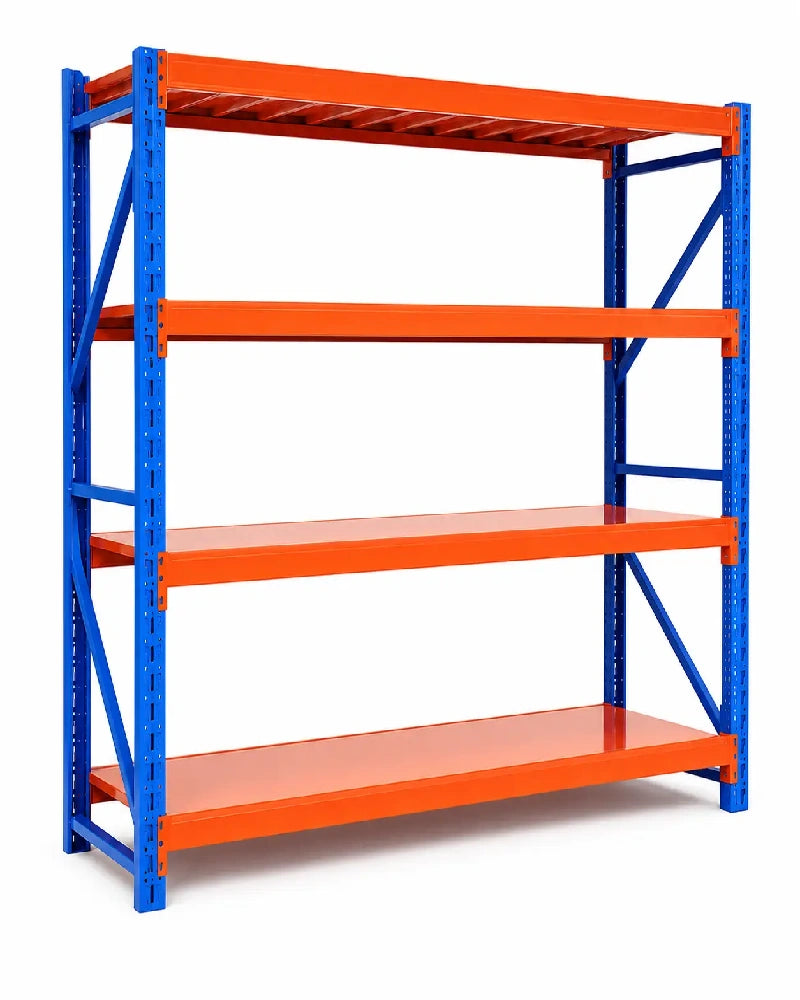


Shelf beam types are best compared as part of a complete storage rack system—not by profile shape alone. A deeper or more complex-looking beam may resist bending differently from a shallow beam, but the useful buying question is whether the beam, connection, deck, uprights and intended span are documented for your actual load and configuration.
This guide explains the visible differences storage rack buyers can compare without turning appearance into an engineering claim. It applies to common freestanding shelving used in garages, workshops, stockrooms and light commercial spaces in Australia and the United States. If you are specifying pallet racking, elevated work areas, seismic restraint, vehicle-accessed storage or another regulated installation, use the supplier's technical documentation and obtain advice from a qualified local professional.
What is a shelf beam?
A shelf beam is the horizontal member that runs between two upright frames or posts. It supports the shelf deck and transfers the applied load into the uprights. Most storage levels use a front beam and a rear beam, although some systems add intermediate supports, deck supports or braces.
The beam should never be judged in isolation. Its performance depends on the complete load path:
- the stored item and how its weight contacts the shelf deck;
- the deck material and any intermediate supports;
- the front and rear beams;
- the beam-to-upright connectors and safety locks;
- the uprights, bracing, feet and anchoring arrangement; and
- the floor or supporting structure beneath the unit.
That is why two beams with a similar face height can belong to systems with different published ratings, assembly rules or permitted spans.
Common shelf beam profile families
Manufacturers use different names for similar shapes, so treat the following as visual categories rather than universal specifications. Always compare drawings and product instructions from the seller of the exact system.
Open channel or folded-channel beams
An open channel is formed by bending sheet steel into a C-, U- or related lipped shape. Extra folds along the edges may increase local stiffness and help the beam resist twisting. Because the rear of the section remains open, buyers can often see the bends and inspect whether the profile is straight and undamaged.
Open channels are common in boltless shelving and modular storage systems. The details that matter include the profile depth, flange and lip geometry, steel specification, connector design, span and how the shelf deck bears on the beam. A channel should not be assumed stronger or weaker simply because it has more folds.
Box or closed-section beams
A box beam has a closed or nearly closed cross-section, sometimes formed from multiple folds or joined seams. Closed sections can provide torsional rigidity, but the real result still depends on material, dimensions, manufacturing, connector details and span.
When inspecting a box-style beam, look for straight faces, consistent seams, undamaged ends and connectors that seat fully. Do not drill, cut or modify a closed beam unless the exact product instructions allow it, because alterations can change how forces travel through the member.
Stepped or lipped beams
A stepped beam includes a ledge intended to support a shelf panel, wire deck, timber deck or another specified surface. The ledge helps locate the deck and can create a flatter storage level. Its presence does not confirm compatibility with every deck material.
Check the required deck thickness, bearing width, support-bar arrangement and edge clearance. A panel that is too thin, too short or not approved for the system may not transfer load as intended. The deck should sit flat without rocking, forced bending or large unsupported gaps.
Angle and light-duty rail profiles
Some lighter shelving uses angle-shaped rails or simple folded edges. These profiles can be appropriate for the products and spans they were designed for. Their simpler appearance is not proof of poor quality, just as a bulky beam is not proof of a high rating.
For buying decisions, confirm the published per-level rating, the required shelf surface and whether the stated value applies to an evenly distributed load. If the documentation does not explain the configuration, ask the supplier before ordering.
Beam depth: useful clue, incomplete answer
Beam depth is the vertical dimension of the horizontal member. In otherwise comparable designs, changing depth can materially affect stiffness and deflection. In real products, however, “otherwise comparable” is a demanding condition: steel grade, thickness, folds, seam design, connector length, deck support and span may all change at the same time.
Use beam depth to ask better questions rather than calculate your own capacity:
- What is the exact clear span between uprights?
- Is the rating per shelf level or for the whole unit?
- Does it assume a uniformly distributed load?
- Which deck and support bars are included in the tested or documented configuration?
- Is the beam orientation fixed?
- What deflection or inspection guidance does the manufacturer provide?
For a broader dimensions checklist, see Heavy-Duty Shelving Dimensions: Width, Depth and Height Explained.
Connection types and what buyers should inspect
The end connector transfers force from the beam into the upright. A good-looking beam can still be unsuitable if its connector is damaged, only partly engaged or mixed with an incompatible upright.
Rivet, tab, hook and keyhole-style connections
Boltless systems often use formed tabs, rivets or hooks that enter matching slots in the upright. Installation may require the connector to be tapped or pressed fully into position. Some systems use one engagement point; others use several.
Inspect both ends at every level. The connector should be seated to the position shown in the instructions, the beam should be level, and the upright should not be torn, enlarged or visibly deformed around the slot. Never mix components merely because the slot pattern looks similar.
Bolted connections
Bolted beams use specified fasteners to clamp or locate components. Buyers should confirm that the correct bolt grade, nut, washer, quantity and tightening procedure are available. Replacing missing hardware with a visually similar fastener is not a safe assumption.
Follow the supplied assembly sequence and any torque instruction. If the documentation calls for reinspection after initial loading or use, record that step in the maintenance plan.
Safety pins, clips and locks
Some connectors include a separate pin, clip or locking device intended to reduce accidental disengagement. It is a functional component, not spare packaging. Verify that every required lock is present, undamaged and installed in the stated orientation before loading the shelf.
If a beam can lift, rock or pull away after installation, stop and check the instructions. Do not solve a poor fit with improvised wedges, adhesive, extra holes or unrelated hardware.
Span changes the comparison
Span is the unsupported horizontal distance the beam bridges between uprights. Buyers sometimes compare two products by total width while overlooking differences in upright position, connector length or clear span.
A longer span generally creates a more demanding bending condition, but you should not scale a published rating with a simple rule of thumb. Capacity may not change linearly, and the deck or connection could become the controlling component. Compare products only at the exact width, number of levels and configuration you intend to buy.
Also distinguish storage shelving from pallet racking. Pallet racks interact with forklifts, pallets, impact risks and site-specific design requirements. This article does not provide pallet-rack design or installation guidance.
Deck compatibility can decide the useful beam type
The beam profile and deck must work together. Solid steel panels, wire decking, engineered-wood panels and other surfaces contact beams differently. A stepped beam may create a deck ledge, while another profile may require dedicated clips or support bars.
Before purchase, verify:
- the exact approved deck type and dimensions;
- whether support bars are required and where they fit;
- whether the deck is captured, clipped or simply seated;
- edge support and any permissible overhang;
- environmental limits for the deck material; and
- how damaged panels or supports should be replaced.
Do not place a new panel over a visibly damaged beam to hide the defect. Damaged structural components need assessment and replacement according to the supplier's guidance.
A practical beam comparison checklist
Use the same questions for every shortlisted system so the decision is based on evidence rather than appearance.
- Define the load. Record item weights, dimensions, contact points and whether loads are evenly distributed or concentrated.
- Match the exact configuration. Compare the planned width, depth, number of levels, deck and support arrangement.
- Read the rating correctly. Separate per-level capacity from total-unit capacity and note all stated conditions.
- Review the beam drawing. Check profile depth, orientation, ledges and connection details without assuming these features establish capacity.
- Verify the connectors. Confirm how many engagement points and locks are required and that replacement parts are available.
- Check deck compatibility. Make sure the deck and support bars are approved for that exact beam.
- Plan the site. Check floor condition, aisle clearance, access, impact exposure and anchoring requirements.
- Keep documentation. Retain assembly, loading, inspection and replacement instructions for future users.
For more context on the complete structural system, read What Makes a Heavy-Duty Shelf Truly Strong? and Understanding Shelf Load Capacity.
Red flags before purchase or loading
- No identifiable model or configuration-specific documentation.
- A capacity claim that does not distinguish per-level and total-unit ratings.
- Mixed beams, uprights, decks or connectors from systems not documented as compatible.
- Missing safety locks, braces, feet or support bars.
- Twisted beams, damaged seams, enlarged upright slots or connectors that will not seat.
- A shelf deck that rocks, bows before loading or lacks its specified bearing support.
- Instructions that are unavailable, incomplete or inconsistent with the supplied parts.
If any of these issues appears, pause installation or use. Contact the supplier for the exact documentation, and use a qualified professional where the application, local rules or site conditions require one.
Frequently asked questions
Which shelf beam profile is strongest?
No profile family is universally strongest. Strength and serviceability depend on the full design, material, dimensions, span, connector, deck and load conditions. Compare configuration-specific documentation rather than profile names.
Does a deeper beam always hold more weight?
No. Depth can affect stiffness, but it is only one variable. A deeper beam does not automatically have a higher safe rating than a different system.
Can I mix beams and uprights from different brands?
Only if the manufacturer or supplier explicitly documents the components as compatible. Similar slot spacing or connector appearance is not enough.
What is the difference between beam span and shelf width?
Shelf width is the overall product dimension; beam span is the unsupported distance between its supports. They may be close, but they are not necessarily identical.
Do boltless beam connections need safety clips?
Some do and some do not. Install every pin, clip or lock specified for the exact model and do not treat it as optional.
Can I add my own timber or metal deck?
Only when the product instructions permit that material, thickness, size and support arrangement. An improvised deck can change load transfer and create unsupported edges.
How should I compare load ratings?
Compare the same span, deck, number of levels and load-distribution condition. Keep per-level capacity separate from the total rating for the whole unit.
When do I need professional advice?
Seek qualified local advice for pallet racking, vehicle-accessed storage, seismic or impact exposure, unusual concentrated loads, regulated workplaces, uncertain floors or anchoring, and any case the supplier's documentation does not cover.
Choose the system, not just the beam
A shelf beam profile is a useful part of the buying conversation, but it is not a standalone capacity certificate. Start with the real load and span, verify the complete documented configuration, inspect the connection and deck interface, and keep the instructions for assembly and future checks.
When you are ready to compare available configurations, browse the Heavy-Duty Shelving collection and confirm the exact product specifications and instructions before purchase and use.
Need help choosing?
Find the right storage solution for your space.
Tell us about your room, workspace, quantity, or project requirements and our team will help you compare suitable options.