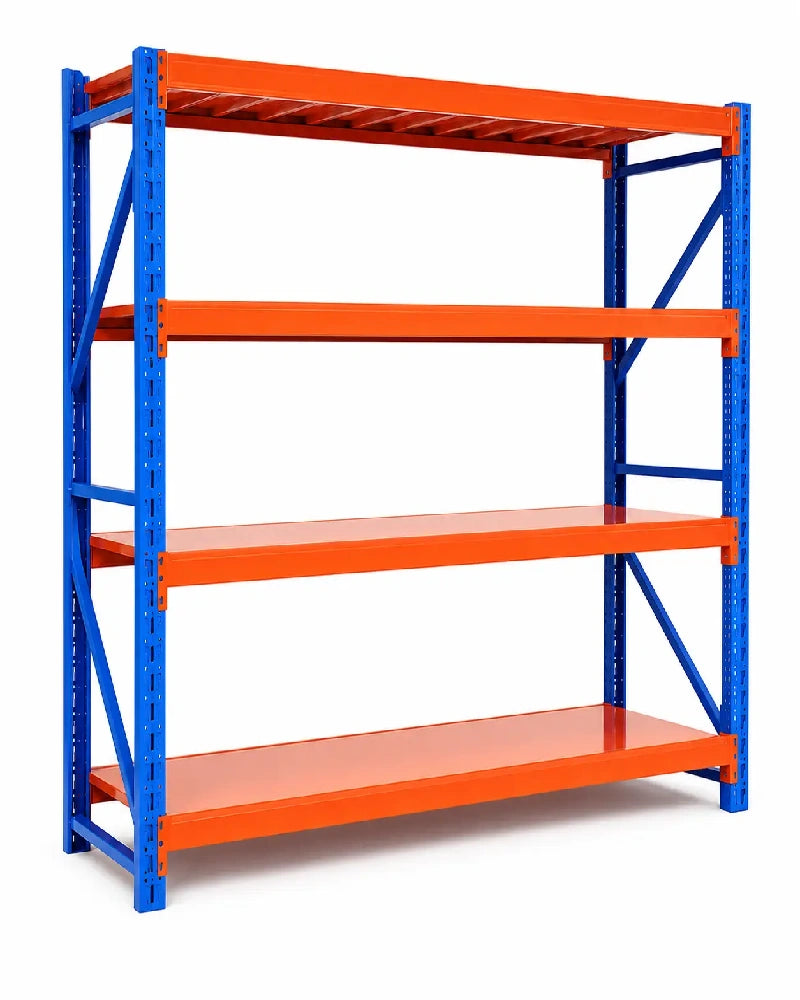


Cold-rolled steel shelving is shelving made partly or wholly from steel sheet or strip that has been reduced between rolls at a relatively low temperature after hot rolling and pickling. The process can produce thinner material with a smoother surface and tighter dimensional control than hot rolling alone. However, “cold-rolled” is a manufacturing description—not a complete statement of shelf strength, load capacity, corrosion resistance or service life.
For a buyer, the useful question is not simply “Is it cold-rolled steel?” It is: What grade, thickness, formed geometry, connection system, coating and verified load rating does the finished shelving use? This guide explains the term and shows how to compare specifications without treating a material label as proof of performance.
What does cold-rolled steel mean?
Steel sheet normally begins as a thicker hot-rolled product. It may then be pickled to remove surface scale and passed through a cold-reduction mill. The American Iron and Steel Institute describes cold reduction as applying pressure, rather than heat, to make sheet thinner and smoother. The World Steel Association similarly defines cold rolling as passing previously hot-rolled and pickled sheet or strip through rolls below the metal's softening temperature.
That reduction changes the sheet's dimensions, surface and mechanical condition. Depending on the required end use, producers may also anneal, temper-roll or coat the material. Those later steps matter: two products described as cold-rolled steel can still have different grades, thickness tolerances, formability, strength values and surface protection.
In shelving, cold-rolled sheet or strip may be cut, punched, folded or roll-formed into shelves, uprights, beams, braces and smaller connection parts. This creates another important distinction:
- Cold-rolled steel describes how flat steel was reduced and finished.
- Cold-formed component describes how sheet or strip was shaped into a profile, usually without heating it to a hot-forming temperature.
- Finished shelving performance depends on the complete assembly, including geometry, joints, bracing, deck support, manufacturing quality and installation.
These terms are related, but they are not interchangeable.
Why manufacturers use cold-rolled steel in shelving
Consistent sheet thickness and dimensions
Cold reduction can support close control of sheet dimensions. That is useful when parts must be punched, bent and connected repeatedly. Consistency can help tabs align with slots, shelf panels sit correctly on supports and matching parts assemble as intended. It does not guarantee that every supplier works to the same tolerance, so the applicable material specification and tolerance should still be documented.
A surface suited to further finishing
Cold-rolled sheet generally has a cleaner, smoother surface than basic hot-rolled sheet. This can be useful before painting, powder coating, plating or another specified finish. The words “cold-rolled” do not identify the final coating, coating thickness or corrosion class. Buyers should treat surface protection as a separate specification.
Efficient forming of detailed profiles
Thin sheet can be folded or roll-formed into channels, ribs, flanges and boxed sections. These shapes can add stiffness and create connection points without requiring a solid, thick block of steel. The visible shape therefore matters, but appearance alone cannot reveal the grade, actual thickness, joint behaviour or safe working load.
Does cold-rolled steel automatically make shelving stronger?
No. Cold working can change a steel's mechanical properties, and cold-rolled sheet can be stronger than the hot-rolled feedstock from which it was made. But that general comparison does not establish the capacity of a shelving unit.
A finished shelf may fail or deflect at its deck, front or rear beam, upright, connector, brace or fastener. Span and load distribution also affect behaviour. A shallow formed rib, a deep channel and a closed box section may perform differently even when made from sheet of the same thickness. Connections can govern the result before the flat material reaches its own limit.
For that reason, do not convert “cold-rolled steel” into an assumed kilogram or pound rating. Ask for the finished model's stated load limit, the conditions attached to that limit and the current product instructions. Our guide to what makes a heavy-duty shelf strong explains how beams, bracing, connections and load distribution work together.
Cold-rolled versus hot-rolled steel: what buyers should compare
| Comparison point | Cold-rolled sheet or strip | Hot-rolled steel | Buyer check |
|---|---|---|---|
| Processing | Further reduced below the softening temperature after hot rolling and pickling | Rolled at elevated temperature | Confirm the exact product form and grade, not only the broad process name |
| Surface | Typically smoother before any final coating | Typically rougher and may show mill scale before further treatment | Check the actual finish and corrosion protection supplied |
| Dimensional control | Often selected where thinner gauges and closer tolerances are useful | Common for thicker structural shapes and plate | Request nominal thickness, tolerance and finished component dimensions |
| Shelving performance | Cannot be determined from rolling method alone | Compare the complete model's documented load conditions and instructions | |
Neither process is universally “better.” The correct choice depends on the component, design, environment and required performance. A well-specified hot-rolled part can be more appropriate than a poorly specified cold-rolled part, and vice versa.
Eight specifications to request before buying
1. Steel grade or applicable material specification
“Steel” and “cold-rolled steel” are broad descriptions. Ask which grade or material standard applies to the main load-bearing components. If the seller cannot provide it, treat any strength comparison as incomplete.
2. Actual or minimum material thickness
Request thickness in millimetres and inches where possible. Gauge numbers can be confusing because conventions vary by material and market. Also clarify whether a value is nominal, minimum base-metal thickness, or a finished measurement that includes coating.
3. Component profile and formed depth
Thickness alone is not enough. Record the cross-section of shelves, beams and uprights, including bends, returns, ribs and closed or open channels. See our guide to shelf beam profiles for a practical comparison framework.
4. Connection and bracing system
Check how beams connect to uprights, how shelves are retained and whether braces or locking devices are required. Confirm that all required parts are included in the exact package rather than inferred from a category image.
5. Finished-model load rating and conditions
Look for a rating tied to the exact model, shelf level, load distribution, assembly method and anchoring conditions where applicable. Do not add shelf-level ratings together unless the manufacturer's documentation explicitly supports that calculation.
6. Coating or corrosion-protection specification
Ask whether the finish is paint, powder coating, zinc-based protection or another system, and whether it is suitable for the intended indoor or outdoor environment. “Cold-rolled” by itself is not a corrosion-resistance claim.
7. Manufacturing and quality-control evidence
Useful evidence may include traceable material documentation, dimensional inspection, coating checks and a documented finished-product test method. The required evidence level depends on the use. A home storage shelf and a regulated workplace installation should not be evaluated with the same assumptions.
8. Current instructions and replacement-part compatibility
Confirm the assembly sequence, required tools, inspection points and rules for replacing shelves, beams, clips or braces. Parts that look similar may use different geometry or tolerances and may not be interchangeable.
How to inspect a product listing or sample
- Match every document to the exact model. A generic factory certificate or material sheet may not describe the finished unit being sold.
- Separate base material from finish. Record the steel grade and thickness independently from paint, powder coating or plating.
- Measure the formed component. Check more than one location and avoid assuming that an outside measurement equals base-metal thickness.
- Inspect edges, bends and punched areas. Look for cracks, severe distortion, sharp unfinished edges or holes that prevent correct engagement.
- Assemble exactly as instructed. Do not omit braces, locks, fasteners or anchoring steps required by the manufacturer.
- Keep the rating label and instructions. They are more useful for future loading and inspection decisions than a broad marketing phrase.
If shelving will be used in a workplace, warehouse, seismic area or other regulated setting, follow the applicable local rules and use a qualified professional where required. Do not modify, weld or drill load-bearing parts unless the manufacturer explicitly permits it.
Common marketing claims to question
- “Cold-rolled means industrial grade.” Industrial suitability needs a defined grade, design, rating and use condition.
- “Thicker always means stronger.” Thickness matters, but profile, span, joints, bracing and material grade also matter.
- “Smooth steel will not rust.” Surface smoothness is not corrosion protection.
- “One load number covers every setup.” Ratings may depend on shelf spacing, uniform loading, assembly and anchoring.
- “The photo proves the construction.” Verify the exact package, part count and specifications in writing.
Choosing the right shelving
Cold-rolled steel can be a practical material for accurate, efficiently formed shelving components. Its real value becomes clear only when the supplier identifies the grade, thickness, profile, finish and finished-product performance. Compare those facts against your item sizes, loading pattern, environment and installation requirements.
Browse Heavy-Duty Shelving to compare available configurations, then verify the current product page and instructions for the exact model before purchase or installation.
Frequently asked questions
Is cold-rolled steel the same as cold-formed steel?
No. Cold rolling reduces and finishes flat steel sheet or strip. Cold forming shapes material into a component such as a channel, upright or shelf profile. A component can involve both processes.
Is cold-rolled steel stronger than hot-rolled steel?
Cold reduction can increase strength relative to the feedstock, but grades and processing routes vary. The phrase alone cannot establish which finished shelving unit is stronger.
Does cold-rolled shelving resist rust?
Not automatically. Corrosion resistance depends on the steel grade, coating system, coverage, damage and service environment. Check the finish specification separately.
Can I compare shelving by steel gauge?
Gauge can be a starting point, but ask for thickness in millimetres or inches and clarify whether the measurement excludes coating. Compare profile geometry and finished-model ratings as well.
Does a smooth surface prove that steel is cold-rolled?
No. Surface appearance can be affected by pickling, coating, polishing and other finishing steps. Use supplier documentation rather than appearance alone.
What is the most important proof of shelf capacity?
Use a load rating and conditions tied to the exact finished model, supported by current documentation. Follow its assembly, load-distribution, inspection and anchoring instructions.
Need help choosing?
Find the right storage solution for your space.
Tell us about your room, workspace, quantity, or project requirements and our team will help you compare suitable options.