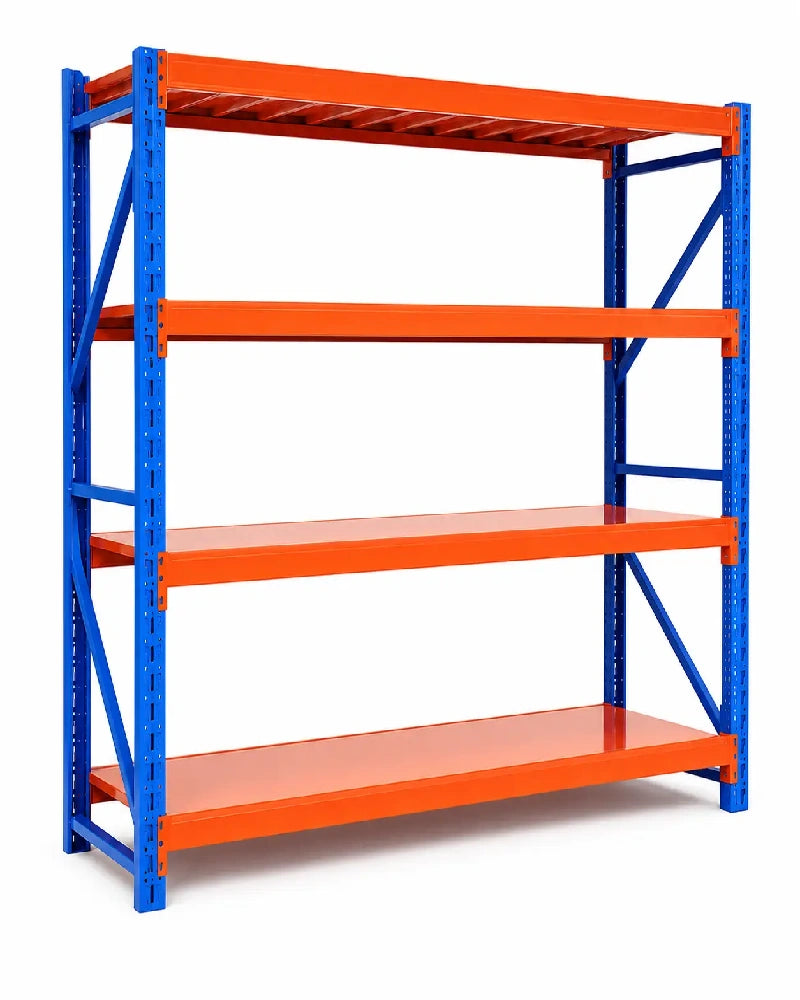


The right shelves for storage totes are the shelves that support each bin fully, leave enough room for handles and lids, and keep the items you use most within comfortable reach. Do not choose shelving from a tote's advertised volume alone. Measure the tote's widest and deepest outside points, then compare those measurements with the shelf's clear opening and usable deck area.
This guide gives you a practical fit-check for garages, workshops and home storage rooms in Australia and the United States. It applies to ordinary household storage bins and totes, not hazardous-material containers or specialised workplace storage.
Start with the tote, not the shelf label
A tote described by volume does not tell you how much shelf space it needs. Two bins with a similar litre or gallon capacity can have different footprints, tapered sides, projecting handles or lids that are wider than the body. Product names such as “medium” and “large” are not standard dimensions.
Measure the actual totes you plan to store. If you are buying new bins, use the manufacturer's outside dimensions and allow for any uncertainty until you can check a physical sample. Record dimensions in inches for a US setup or millimetres for an Australian setup; either system works as long as every measurement uses the same unit.
Measure the three dimensions that control fit
1. Outside width at the widest point
Measure across the widest part of the tote, including handles, latches and any lip around the lid. Do not measure only the narrower base. This dimension determines how many bins can sit side by side between the shelf uprights.
2. Outside depth at the longest point
Measure from the frontmost to the rearmost point, including the lid rim. Compare that number with the shelf's usable front-to-back deck depth. The tote should sit fully and stably on the intended deck; avoid planning around unsupported overhang.
3. Closed height plus operating clearance
Measure the tote with its lid fitted. Then add the space needed to grip the handles, pull the bin forward and remove or hinge the lid. A bin that technically enters an opening may still be frustrating to use if your fingers cannot reach the handle or the lid hits the shelf above.

Measure the shelf's usable space
Overall shelf dimensions can differ from the space available to a tote. Measure the actual opening and deck where the bin will sit.
- Clear width: the unobstructed distance between uprights, braces or other components.
- Usable depth: the supported deck area from front to back, not the maximum outside depth of the frame.
- Clear height: the distance from the top of the deck to the lowest obstruction above.
- Access path: the room required to approach, grip and remove the tote without striking a vehicle, door, wall or adjacent bin.
If you are comparing common garage shelf depths, use our garage shelf depth guide to understand the trade-offs. A deeper shelf is not automatically better: it may reduce aisle space and make smaller bins harder to reach.
Use a simple fit calculation
For a first pass, compare tote width with clear shelf width, tote depth with usable shelf depth, and closed tote height with clear opening height. Every tote dimension must fit inside the corresponding usable shelf dimension.
For side-by-side storage, divide the shelf's clear width by the tote's maximum outside width and round down to a whole number. Then check that handles, lid latches and uprights do not compete for the same space. Treat the calculation as a screening tool, not a substitute for a physical fit test.
Leave a practical margin rather than designing a zero-clearance layout. The right margin depends on the tote shape, how often it moves and how accurately the published measurements match the item in hand. A removable tape outline on the floor or workbench is a quick way to test the footprint before you buy multiple shelves or bins.
Match shelf depth to the bin and the room
A shelf that is too shallow may not support the tote properly. One that is much deeper than the tote can hide small items behind it or consume valuable floor and aisle space. Choose the shallowest shelf that fully supports the intended bin while maintaining the access clearance your room needs.
Also check skirting boards, wall offsets, garage-door tracks, outlets and other fixed obstacles. These can reduce usable depth or prevent the shelf from sitting where you expected. Our garage measurement guide covers those room-level checks.
Plan shelf spacing around access
Adjustable shelf levels can help when a tote collection includes several heights. Before setting a level, place the tallest intended tote below it and test the complete movement: approach the shelf, grip the bin, pull it clear and open the lid. If the bin is heavy or awkward, a theoretically efficient position may not be a practical one.
Frequently used totes usually work better between knee and shoulder height. Reserve less convenient upper and lower positions for lighter or less frequently accessed items. Do not climb shelving or improvise unsafe access. Follow the shelving instructions and use suitable access equipment where required.
Check load and deck suitability separately
Dimensional compatibility does not prove load compatibility. Add the weight of the tote and its contents, then compare the total with the exact shelf model's instructions and rating label. Account for every item sharing that shelf level and distribute the load as the manufacturer directs.
The deck surface also matters. A bin's feet or narrow base should have stable support and should not sit in a way that can rock, deform the deck or slip into an opening. Do not assume that a shelf is suitable for a tote merely because the tote fits between the uprights.
For workplace, anchoring or unusually heavy storage decisions, follow the product documentation, applicable local requirements and qualified advice. This guide does not establish a load rating or installation method for any specific shelf.
Choose a repeatable bin system
Standardising a few tote footprints can make future storage changes easier. You can move bins between levels without rebuilding the entire layout, keep replacement purchases predictable and avoid small gaps that are difficult to use.
Standardisation does not mean every tote must be identical. A practical system might use one shallow bin for frequently accessed supplies, one medium footprint for general storage and one larger footprint for lightweight bulky items. The important point is to record the outside dimensions and assign each type to a shelf opening that actually fits.
Run a physical fit test before buying in quantity
- Measure one sample tote at its widest, deepest and tallest outside points.
- Measure the shelf's clear opening and supported deck area.
- Place the sample tote on the intended level with the normal lid and handles fitted.
- Open, close, grip and remove it as you would in daily use.
- Check the aisle, door and vehicle clearances with the tote partly withdrawn.
- Confirm the exact shelf's instructions and load limits for the planned contents.
A sample test is especially valuable when you plan to buy many matching bins. A small difference in a lid rim or handle can turn a neat spreadsheet layout into a poor real-world fit.
Common mistakes to avoid
- Using nominal volume instead of outside dimensions.
- Measuring the tapered base while ignoring a wider lid or handle.
- Comparing the tote with the shelf's overall frame size instead of clear space.
- Allowing no room to grip the bin or remove the lid.
- Letting bins overhang because their bases appear stable.
- Planning shelf quantity before testing one real tote.
- Treating dimensional fit as proof of safe load capacity.
A practical buying checklist
Bring these figures together before comparing shelves: maximum tote width, maximum tote depth, closed height, desired lid clearance, loaded weight, number of bins per level, and the available room footprint. Then compare them with clear shelf width, usable deck depth, clear level height, exact-model load information and aisle clearance.
For a broader view of size, strength and room layout, start with our garage shelving guide. When you are ready to compare current options, browse garage shelving and verify the product page dimensions and instructions against your tote measurements before ordering.
Frequently asked questions
What shelf depth is best for storage totes?
The best depth is one that fully supports the tote's outside footprint without using more room than your aisle can spare. Measure the physical bin and the shelf's usable deck; do not choose from the tote's volume label alone.
Should a storage tote hang over the shelf?
Plan for full, stable support on the intended deck. Overhang can make the tote less stable and may conflict with the shelf instructions. If the tote is deeper than the usable deck, select a different tote or shelf.
How much clearance should I leave above a tote?
Leave enough space to grip the tote and operate its lid in the way you intend to use it. Test this with the actual bin because handle and lid designs vary.
Can I calculate how many totes fit on one shelf?
Divide clear shelf width by each tote's maximum outside width and round down, then verify the result with a physical test. Uprights, handles and latches can reduce the space available in practice.
Are adjustable shelves better for mixed tote sizes?
They can make it easier to change level spacing, but adjustability does not confirm capacity or compatibility. Check the exact shelf instructions, supported deck area and the loaded weight of every tote.
Should heavy totes go on the bottom shelf?
Lower placement can reduce lifting height, but the correct layout depends on the shelf instructions, total load, access and the user's handling needs. Keep heavy or awkward items within a safe handling range and seek qualified workplace guidance where required.
Need help choosing?
Find the right storage solution for your space.
Tell us about your room, workspace, quantity, or project requirements and our team will help you compare suitable options.